Artist Profile
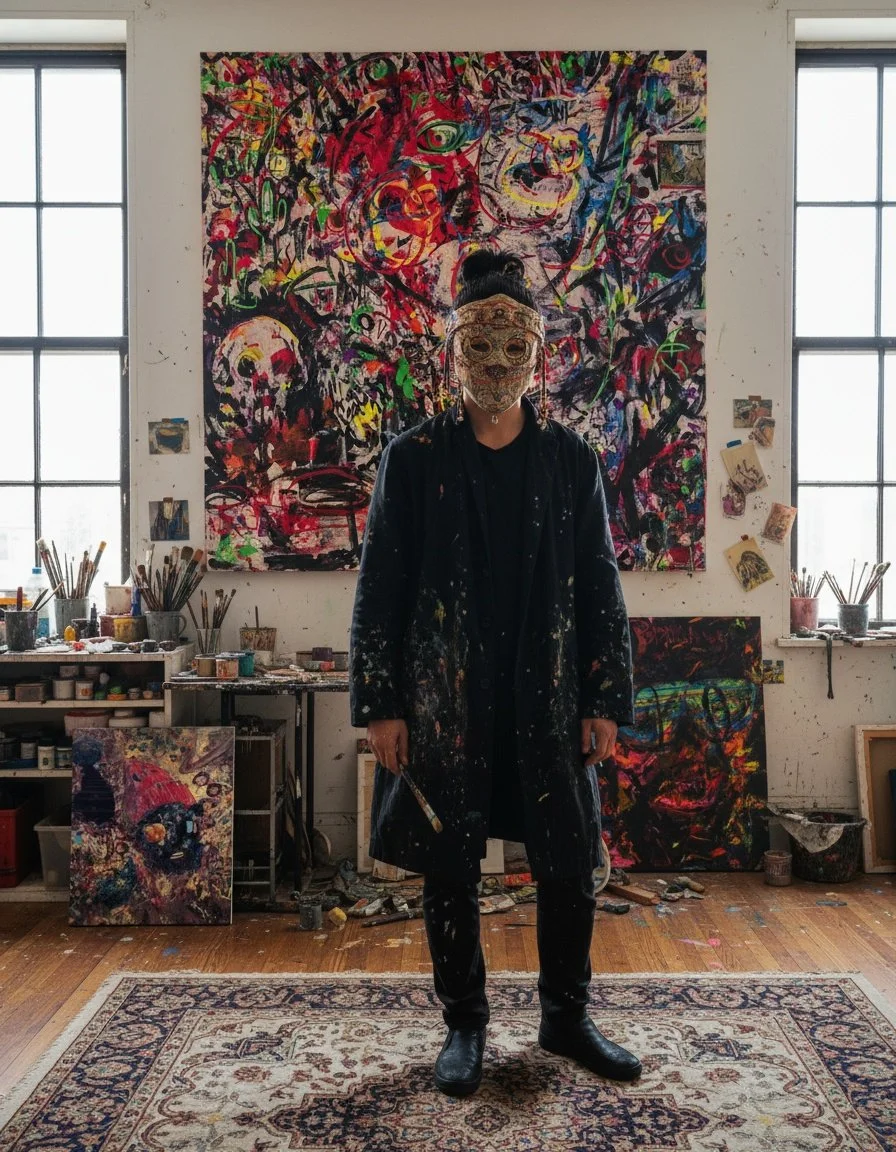
In the world of John Magnus, painting behaves like archaeology — a slow excavation of emotional sediment. Each surface trembles between figuration and abstraction, as if the artist were reconstructing a body from memory rather than from life. His practice fuses the urgency of street expressionism with the restraint of post-conceptual painting: fluorescent scars over hushed earth tones, anatomical ghosts emerging from layered silence.
Magnus works in mixed media — acrylic, ink, marker, latex, collage — but it is his psychological tempo that unites them. His compositions recall the interior architectures of George Condo and the wounded sensuality of Francis Bacon, yet his temperament is more philosophical: each mark is a sentence in an unfinished scripture about perception and erasure. The canvases oscillate between control and surrender, offering viewers the uneasy intimacy of remembering something they never lived.
His masked presence operates as both symbol and ritual — anonymity as devotion, the self dissolved into process. In this duality, Magnus situates himself among contemporary myth-makers who use absence as authorship. The mask becomes a recurring relic, a visual stand-in for the artist’s withdrawal and his simultaneous insistence on being seen through the act of painting itself.
To encounter a Magnus painting is to stand before an artifact of emotional archaeology — raw, cerebral, and luminous, where philosophy and feeling meet in mutual ruin.
John Magnus is a multidisciplinary artist whose mixed-media works merge surrealist psychology with philosophical abstraction. Working in acrylic, ink, and latex on canvas or wood, his language blends graffiti gestures, collage fragments, and fluorescent traces over muted grounds. Through recurring motifs of distortion and disappearance, Magnus constructs a visual lexicon of memory — what the mind forgets but the body remembers.